Key Takeaways:
- AI coding tools and no‑/low‑code platforms prioritize visible functionality over secure architecture. They make apps look ready but rarely ensure strong access control, data encryption, or compliance with HIPAA and NHS standards.
- Founders using “AI will build it for me” tools often become accidental junior developers, assembling functional pieces without noticing hidden security flaws.
- AI‑built MVPs frequently fail compliance checks because they lack audit logging, proper role management, and EU/UK data residency options.
- Generative AI can mis-implement or omit requested security features, such as token expiration or encryption settings, leading to subtle but dangerous vulnerabilities.
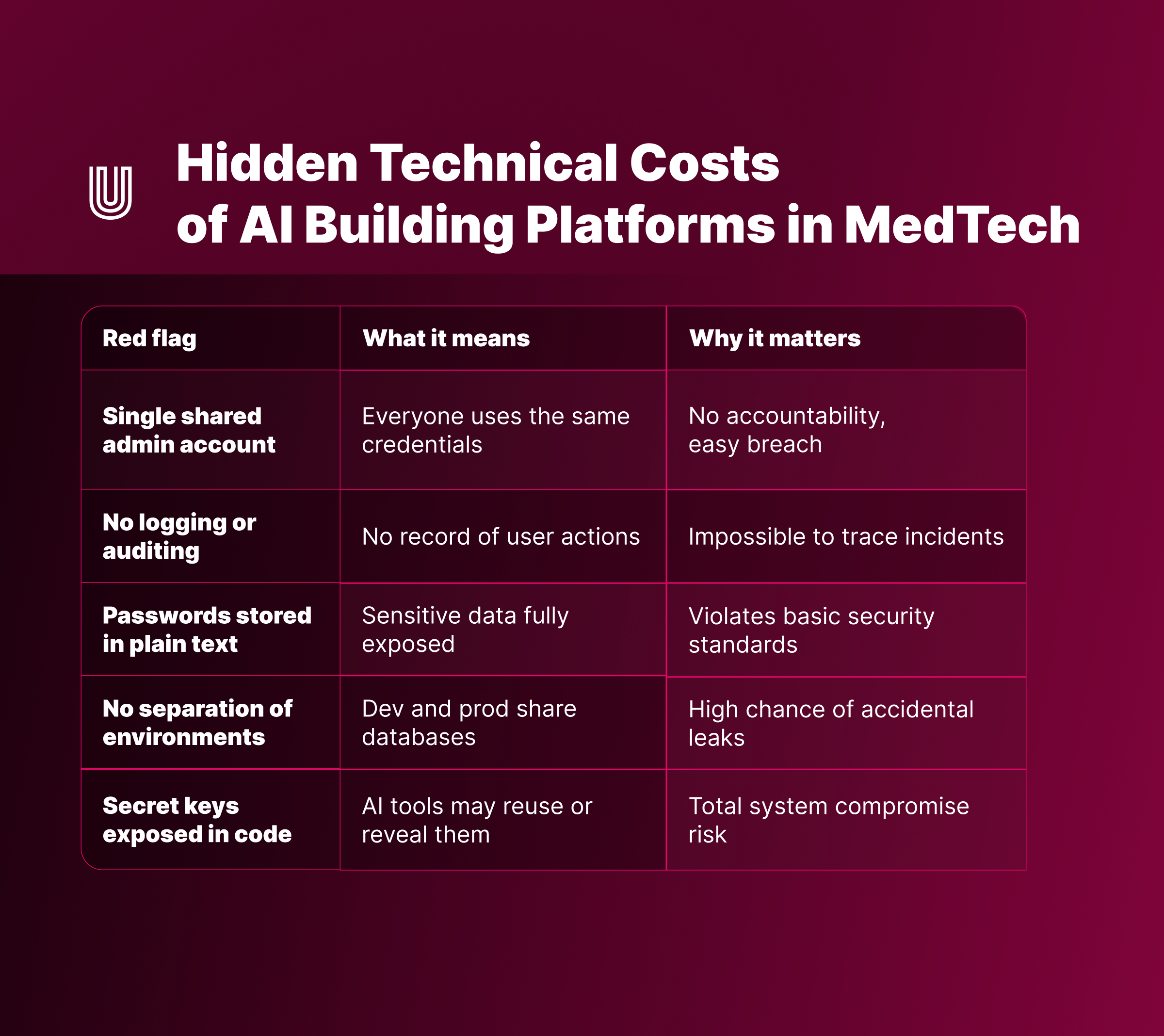
- If your MVP has a shared admin account, no logging, or exposed keys, it needs a rebuild, not a patch. These are not superficial bugs but foundational security failures.
- In MedTech, speed cannot replace security. Start with AI prototypes if needed, but always validate and harden them with experienced software engineers before going live.
- Partnering with a team like ULAM LABS ensures your digital health product is both innovative and regulation‑ready - combining AI‑assisted productivity with real engineering and compliance expertise.
When “It Just Works” Isn’t Enough in MedTech
For non‑technical founders, AI coding agents and no‑/low‑code platforms feel like magic: you describe what you need, click a few buttons, and a working prototype appears. But in digital health and MedTech, where data privacy, compliance, and patient safety are non‑negotiable, “it works” is very different from “it’s safe and audit‑ready”.
At ULAM LABS, we regularly meet startups that started this way: their MVP looked great on the surface, yet behind the scenes it exposed sensitive data or failed a basic security review. The issue isn’t that AI is bad - AI is brilliant at accelerating development - the trap is assuming it also takes responsibility for architecture, security, and compliance.
Why “AI Will Build It for Me” Is a Trap
Generative tools are optimised for visible results: making the app look and behave correctly. What they do not design for you is a secure, compliant architecture. When founders lean on AI tools without a strong technical background, they unintentionally step into the role of junior developers: good at assembling functional pieces, but unaware that some of those pieces may quietly open serious security gaps.
For example, an LLM might generate a login system in seconds but skip robust password hashing or fail to enforce role‑based access controls. It is incentivised to please the user by delivering results fast, not to protect the user by enforcing best‑practice security patterns. That difference matters when you are handling personal health data under HIPAA, GDPR, or NHS rules.
If you want to understand how these regulations shape a product from planning to post‑launch, check our full‑cycle guide to healthtech compliance.
What AI Builders Usually Don’t Guarantee
Even when AI coding platforms promote “secure by design” features, they rarely guarantee compliance or data‑residency control. Common issues include:
- No default “HIPAA‑ready” or “NHS‑ready” configurations
- Lack of access control, audit logging, or encrypted data flows
- Server hosting restricted to the US - without regional choice or EU data residency options
- Mis‑implemented security features when you request them (e.g., token expiry or encryption flags missing in generated code)
AI tools optimise for speed, not audit readiness. In MedTech, that’s a risk you can’t outsource to a cloud vendor or chatbot.
The “Looks Great, but Leaks Data” MVP
Imagine a MedTech founder launching an AI‑built MVP for clinical questionnaire management. It looked sleek, the demo impressed investors, and the pilot site was ready. Then the hospital’s IT team ran a basic scan, and found public endpoints exposing patient forms. No access roles, no logging.
Trust evaporated overnight. The startup had to rebuild the backend from scratch andmigrate all data. A three‑month pilot turned into a six‑month delay (not mentioning a much larger bill).
The product’s failure wasn’t technical but rather was one of misplaced confidence. The AI made it work, but no one asked whether it was secure.
Want a deeper dive into the security & compliance side?If you’re planning a new digital health product, we’ve put together a practical guide for non‑technical founders on what “secure & compliant” really means in UK healthcare – and what to fix before you build.
👉 Download our free ebook “Before You Write a Single Line of Code”
The Hidden Technical Costs
There’s more beneath the surface:
- Server location lock‑in: Many AI‑driven app builders deploy only to US‑based servers. You rarely get to choose the region, making EU or UK data compliance tricky.
- Exponential maintenance costs: The more you scale, the faster your platform bills grow - often outpacing the cost of healthcare custom software development.
- Ecosystem dependence: Popular “vibe coding” platforms rely on proprietary backends. Migrating away later means rewriting 50%+ of your app because core logic lives within their infrastructure.\
Final Thoughts
AI tools are powerful accelerators, but they cannot replace architecture, threat modelling, or compliance thinking. In regulated industries like digital health, the real question is not “Can AI build this?” but “Should AI build this, and under whose supervision?”. If your goal is an MVP that is both impressive and safe to take into hospitals, a hybrid approach works best: use AI to explore and prototype, then rely on experienced engineers to design the architecture, review the code, and harden it for real‑world audits.
At ULAM LABS, we help MedTech founders combine the creative speed of AI with secure-by-design engineering, audit‑ready logging, and region‑aware hosting that align with HIPAA, GDPR, and NHS expectations.